On The Mend · No-Contact Rule
The 30-Day No-Contact Challenge: A Real Plan


The 30-day no-contact challenge is a one-month boundary you set with yourself after a breakup: zero direct contact with your ex, including texts, calls, DMs, story views, story replies, social-media lurking, and asking mutual friends for updates. Thirty days is enough time for the early withdrawal curve to peak and start descending, for the dopamine loop to weaken, and for you to remember what your own life felt like before this person was in the center of it. It's not a magic spell to get them back. It's a thirty-day commitment to not bleed into the wound while it tries to close.
The 30-day promise (and what it actually does)
The promise of the 30-day challenge is not that day 31 will be a magical reunion. The promise is more honest and more useful:
- Your brain will stop reflexively reaching for your phone every time you feel something hard.
- The cravings will weaken. Helen Fisher's work on the neuroscience of romantic rejection shows the loss circuitry behaves like substance withdrawal, and like any withdrawal it peaks and then falls.
- You will remember things you like that aren't them. Songs, foods, parts of your apartment, hobbies you'd let go.
- You will gain enough emotional altitude to actually look at the relationship instead of just missing it.
- You will have one piece of solid evidence that you can do hard things on purpose.
That last one is the real prize. The streak is not about them. It's a 30-day demonstration to yourself that you keep your own promises now.
The seven-step setup (do this in the first 24 hours)
This is the HowTo. Run through it before bed tonight if possible. If you've already broken some of these, redo them.
- Block or mute everywhere. iMessage, Instagram, TikTok, Snap, BeReal, Venmo, Spotify, LinkedIn, anywhere their name can surface. Block is better than mute. This is environmental hygiene, not pettiness.
- Archive or delete the text thread. Delete if you can stomach it. Otherwise archive, but only if you genuinely will not re-read. The thread is a private slot machine.
- Tell one friend. Pick the one who will not panic-text you at 1am to ask if you want to break it tonight "just this once." Send them the date your challenge ends.
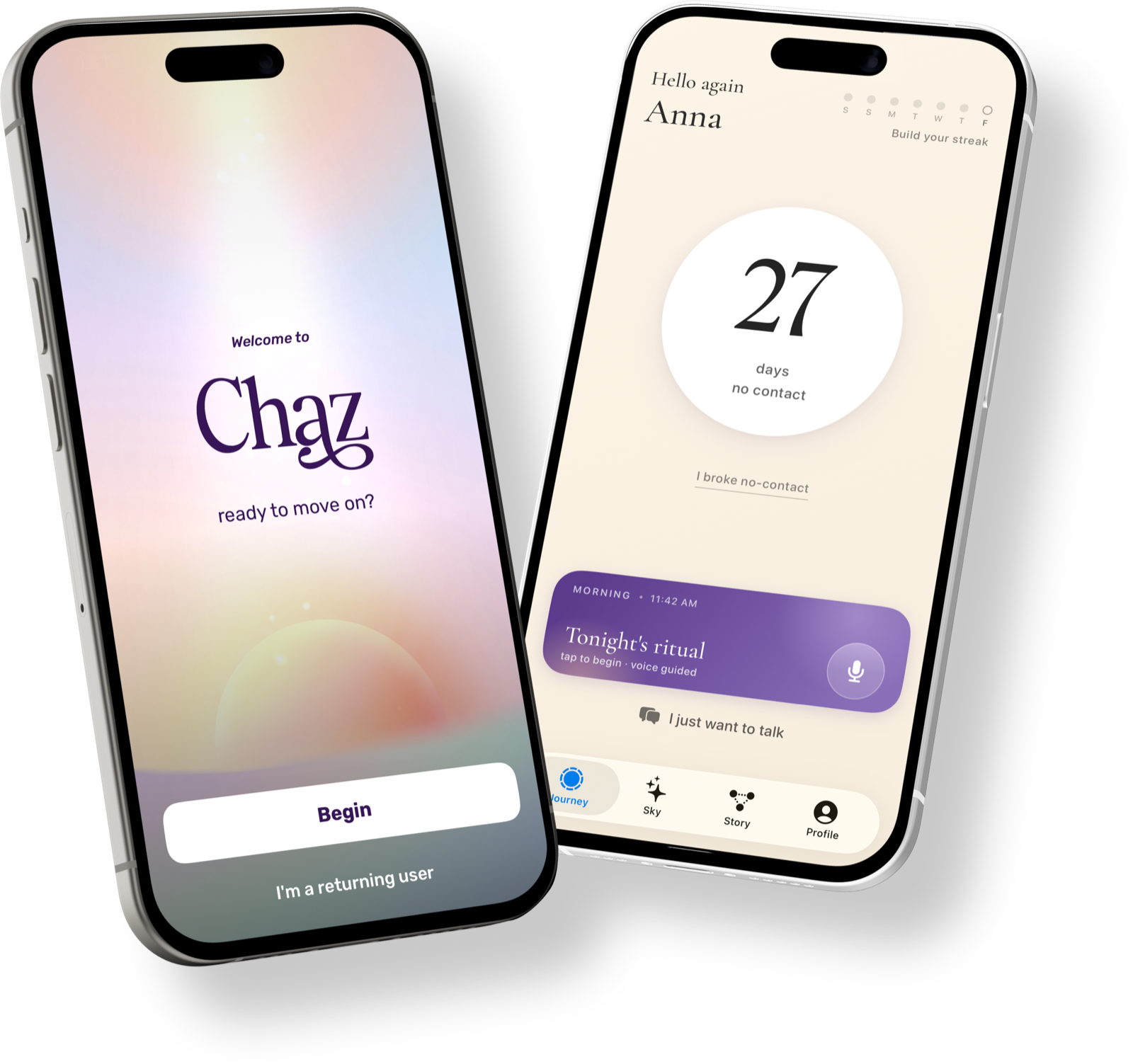
- Set up a visible streak counter. A calendar, a habit tracker, or Chaz, which is a free iPhone app built around exactly this. The counter has to be visible or it does not do its job.
- Plan two replacement rituals. One daytime: gym, walk, recurring coffee date with a friend. One nighttime: bath, book, journal, voice memo, AI conversation. Pre-decide so you're not choosing under duress.
- Write the "why I'm doing this" letter. Handwritten, dated, one page. List the actual reasons it ended or you ended it. Keep it where you can find it at 2am. You will need it.
- Pre-write the 2am protocol. When the urge hits and your defenses are down, what exactly do you do? Walk around the block, voice memo to yourself, journal in a notebook, yell at an AI agent, call the one friend. Pick two. Write them down.
That setup is the whole engine. Most people who fail a 30-day challenge skipped steps 5, 6, and 7.
What each week is going to feel like
Individual mileage varies enormously, but this is the rough composite for a relationship of moderate length and intensity.
Week 1: The acute phase
Days 1-7 will feel like the worst version of the breakup, because they are. You're no longer using contact as a numbing agent.
- Crying jags at inappropriate times.
- Drafted messages you don't send.
- Real, physical chest pain. This is not metaphor — severe emotional stress can trigger takotsubo cardiomyopathy, also called broken-heart syndrome. See physical symptoms of heartbreak.
- Sleep is bad.
- You will not believe this is going to feel better in three weeks.
The rule for week 1 is simply: do not contact them. That's it. You do not need to feel good. You just need to not text. Lower the bar to "I am alive and I did not text him today" and call it a win.
Week 2: The fog
Days 8-14 are the fog. You are functioning. You're at work. You are on autopilot. You're checking their social media too much even if you blocked, because you found a workaround through a friend's account or a search bar. Research on Facebook surveillance of ex-partners found this kind of monitoring predicts greater post-breakup distress and lower personal growth — the workaround is doing damage even when no message gets sent.
This is the most dangerous week, because it's quiet enough that you start telling yourself "maybe I could just text once to see how they're doing, I'm doing so much better." You're not better. You're tired. The fog is not improvement. It's the in-between.
Stay the course. Use your replacement rituals. Cut the workaround channels you discovered in week 1.
Week 3: The first lift
Days 15-21 are where something actually shifts. A song that used to wreck you plays and you make it through the chorus before noticing. You go a whole afternoon without thinking about them and then panic at dinner because you didn't. You laugh at a meme and it's not performed.
This is the early descent of the withdrawal curve. Do not interpret it as "I'm fixed now" and break no contact. Interpret it as "the rule is working, keep going."
Week 4: Reorganization starts
Days 22-30 are reorganization beginning. You're picking up something old or starting something new. You're sleeping better. You can think about the relationship clearly enough to actually see what was wrong with it, instead of just missing the good parts.
By day 30 you'll have a choice. Most people who feel the lift by week 3 will want to extend to 60 because they can feel the curve still falling. Some will be ready to enter day 31 as a calmer person who happens to no longer text their ex. Either choice is fine. Just don't break no contact on day 30 like it's a finish-line meal at the end of a fast.
The relapse plan most guides skip
You will probably slip. Almost everyone does. The slip is not the failure. The reaction to the slip is what determines whether the challenge holds.
- If you sent a text and they didn't reply. Block them on that platform now. Today. The slip is contained because there was no reinforcement. Do not restart the count; treat it as a stumble. Just patch the leak.
- If you sent a text and they replied warmly. This is the hardest scenario. Your brain is going to flood with relief and you'll want to keep going. Don't. Close the conversation with a one-line "I shouldn't have reached out, I'm going back to no contact. Take care." Then block and restart the count. The warmth is the slot machine paying out a small win to keep you playing — variable-ratio reinforcement is famously the hardest schedule to extinguish.
- If you sent a text and they replied cruelly. Reaffirm the rule and restart the count. You just got a free reminder of why you're doing this.
- If you've been checking their social media but not texting. Cut that channel today and don't restart the count. You haven't broken the actual rule; you've been undermining its effect. Patch and keep going.
- If you fully restarted communication for a week and now you're back. Reset the count. Pick 30 again, or move up to 60. Take five minutes to write down what you learned about your trigger so the next attempt holds.
The pattern: contain the leak, do the honest accounting, restart only when the actual rule was broken, and always extract a lesson before resuming.
Two scenarios you will face
It's day 6, 11:47pm. You're in bed, your phone is in your hand, and you've drafted the text three times. Each draft is slightly more carefully worded than the last. The protocol says walk or voice memo. You don't want to. You voice-memo anyway, badly, while crying. You don't send the text. You fall asleep with your hair wet. Day 7 begins. That's the win.
It's day 22. You're at brunch with a friend who casually says "oh by the way I saw him at the bar last week, he looked rough." Your brain immediately wants to ask seven follow-up questions. You say "I don't want to know, but thank you," and you change the subject. Three minutes later you're laughing about something else. That's the lift.
How Chaz makes the streak survive
The 30-day challenge fails most often in the 2am window, when the urge spikes and there is no one awake to talk to. That is the gap Chaz was built for.
Chaz is a free iPhone app that tracks your no-contact streak so it visibly has something to lose, and gives you an AI voice agent to yell at instead of texting your ex. You pick up the phone, you scream the thing you were going to send, the AI yells back, and twenty minutes later the urge has discharged through a safe channel. The app journals what you said, so on day 24 you can read the receipts from day 4 and feel the distance.
Tagline is what it does: don't text him, talk to Chaz.
On day 31
You wake up. You do not text them. Some part of you notices that the urge is smaller than it was on day 1, and some part of you is sad about that, because the urge was the last thing that felt like the relationship.
This is the day to decide: extend to 60, extend to 90, or end the formal challenge and just stay in the new groove. There's no wrong choice. The win was the 30 days you already did.
You kept a promise to yourself. The person who can do that is the person who heals.