On The Mend · Tactical
How to Actually Do No Contact (A Step-by-Step Guide)

How to actually do no contact: pick a duration, hard-block on every platform, delete the threads, tell one accountability person, set up a streak tracker, plan the rituals that replace the contact habit, and build a 2am protocol before you need it. No contact only works when you stop relying on willpower in the worst moments and start engineering the environment in the calm moments. This is a 9-step playbook for the first 30 days, the bit nobody actually walks you through.
What no contact really means
No contact means zero communication with your ex. No texting. No calls. No DMs. No liking their posts. No checking their stories. No driving past their place. No third-party gossip pipeline. No "just one quick birthday text."
It is not punishment. It is not a manipulation tactic. It is not a countdown to a magical reunion. It is the only condition under which your nervous system gets a chance to reset.
Helen Fisher's fMRI work on heartbreak found that romantic rejection lights up the same brain regions as cocaine craving — the ventral tegmental area, the nucleus accumbens. You are, biochemically, in withdrawal. Every text exchange is a hit. No contact is detox.
Step 1: Decide your duration
Pick a number. 30 days minimum. 60 if it was a long relationship. 90 if there was real damage or a narcissistic dynamic. Research on post-separation contact found that in-person contact with an ex predicts higher psychological distress two months later, so the duration matters most for people without shared kids forcing the channel open.
Write it on a sticky note. Write the end date too. The point is to stop renegotiating it every time you feel sad. If you decide on Tuesday afternoon that the rule is "30 days starting today, ending June 24," then at 2am on day 11 you don't get to vote.
If you're not sure, start with 30. You can extend. You can't un-extend without losing the streak.

Step 2: Block or mute on every platform
The full list, because the platforms you forget are the ones that get you:
- Phone (block the number in iPhone Settings, not just Contacts)
- iMessage and SMS
- Instagram (block, don't just unfollow)
- TikTok
- X / Twitter
- Snapchat
- Facebook and Facebook Messenger
- LinkedIn (yes, really)
- Email (block sender, route to a folder you don't open)
- Venmo, Cash App, Zelle
- Spotify (unfollow so they can't see your sad playlist)
- Find My / Find My Friends
- Any dating apps where you might cross paths
If a full hard block feels too dramatic, mute aggressively: hide their stories, mute their posts, turn off notifications. But block the DM. The DM is the door. Tara Marshall's research at Brunel found that even passive Facebook surveillance of an ex — no messages exchanged — predicts greater post-breakup distress and lower personal growth.
Step 3: Delete or archive the thread
Open your messages app. Find the thread. Long-press. Delete.
If deletion feels like grief, archive instead. Move it to a folder labeled "do not open." On iPhone you can also use the Hide Alerts toggle and bury the conversation in your filters. Same logic across WhatsApp, Instagram DMs, Snapchat.
The point is to make rereading old conversations a deliberate act, not a thumb reflex. Re-reading the thread is a relapse with extra steps.
Step 4: Tell one accountability person
One person. Not five.
Pick the friend who will not say "you do what's best for you" when you call them at 11pm clearly about to do something stupid. Pick the friend who will say "absolutely not, put the phone down, tell me what you were going to write."
Text them now. Tell them the duration. Tell them you might call at odd hours. Ask if they're in.
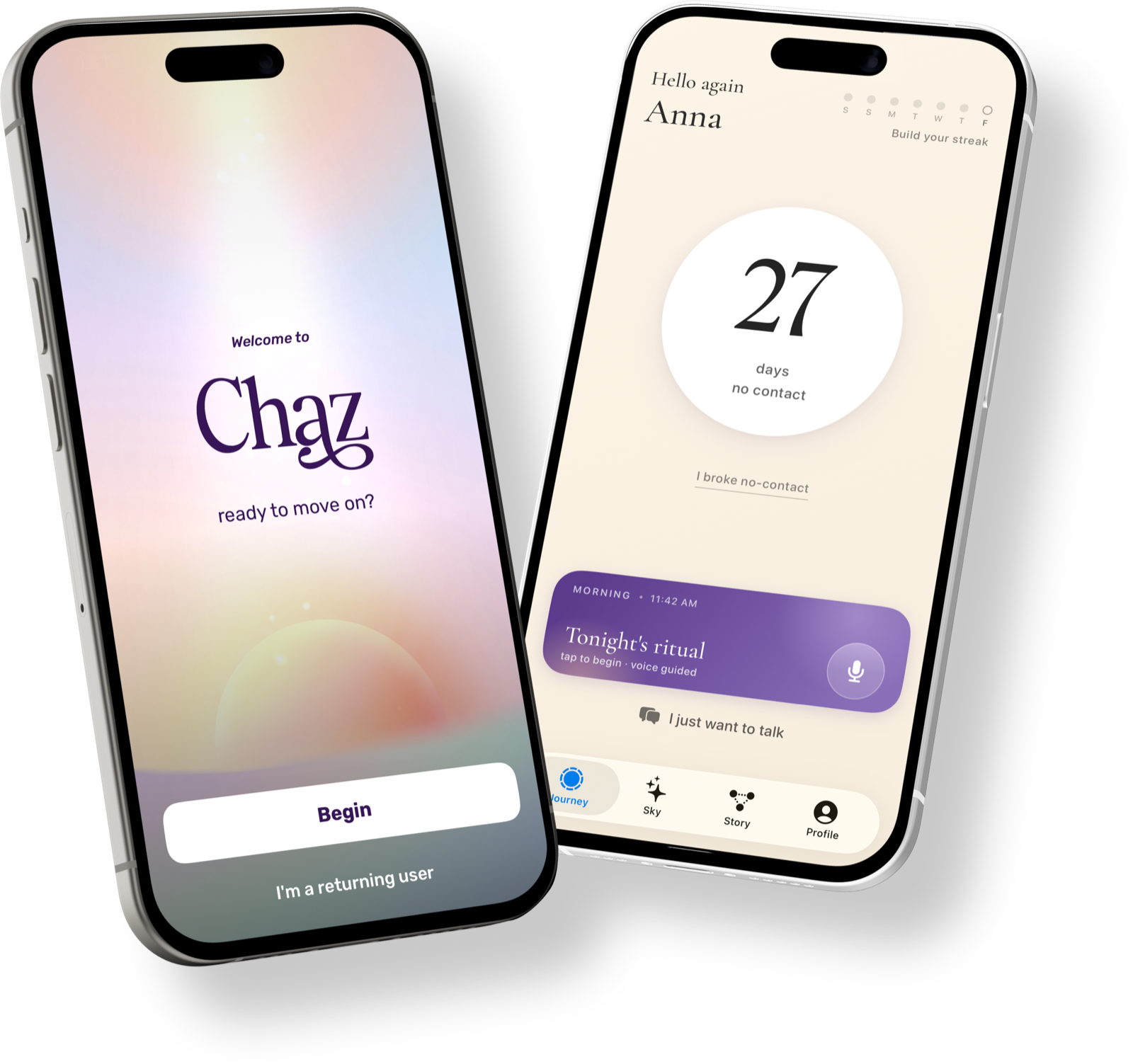
If you don't have that friend, the Chaz app exists for exactly this. It's an AI you yell at instead of texting your ex, with a streak tracker and a journal.

Step 5: Set up a streak tracker
You need a number that grows.
Use a habit-tracker app, a paper calendar with X's, or a dedicated no-contact app. The mechanism matters less than the visibility. You want to see the streak every morning so that breaking it feels like a tangible loss, not just an abstract failure.
Day 1 is the worst. Day 7 you start to notice. Day 21 the urge frequency drops noticeably. Day 30 you can usually feel the shift in your body. The number is the receipt.
Step 6: Plan replacement rituals
Whatever you used to do with them or because of them needs a substitute. Not a placeholder — an actual upgrade.
- Morning text habit: replace with a 10-minute walk and a podcast.
- Lunch call: replace with calling a different friend on a rotation.
- Goodnight text: replace with a journal entry, a book, or a guided wind-down.
- Weekend brunch spot: replace with a new spot you didn't share.
- Their playlist: build a new one. Title it whatever you want.
The first two weeks feel hollow. The hollow is the point. You're clearing space.
Step 7: Write a "why" letter to your future self
On a calm afternoon, write down every reason you're doing this. The specific things. The fight on the kitchen floor. The way you felt on your birthday. The text you sent your friend at 3am. The thing they said you can't unhear.
Save it in your Notes app, pinned. Title it something like "Read before texting." Future you, at 2am, is a different person with no access to today's clarity. You're leaving them a receipt.
Step 8: Build the 2am protocol
The urge to break no contact is not constant. It spikes. The spikes happen predictably: late at night, after drinking, after good news, after seeing a couple in public, after a song.
Build the environment now so the spikes can't reach you:
- Phone charges in another room overnight.
- Do Not Disturb auto-on from 11pm to 7am, with your accountability person on the exception list.
- An app blocker (Opal, ScreenZen, or iOS Screen Time) on social and messages overnight.
- Your accountability friend's number pinned at the top of your favorites.
- A Notes app file called "Drafts I didn't send" where you write the text but don't send it.
If you'd rather yell out loud than write, Chaz takes voice. You can rage at it. It doesn't get tired.
Step 9: Schedule weekly check-ins with yourself
Sunday evening, 10 minutes, same place. Phone in a drawer.
Three questions:
- What hit hardest this week?
- What worked?
- What needs to change next week?
Write it down. Adjust the plan. The plan is not sacred. Quitting no contact entirely is the only option that's off the table.
What to expect, week by week
- Week 1. Worst week. Withdrawal. You will catastrophize, romanticize, bargain. This is brain chemistry, not a sign you should reach out.
- Week 2. The urge gets sharper before it dulls. Around day 10, expect a spike. Ride it.
- Week 3. First glimpse of relief. Hours pass without thinking about them. You notice when it happens.
- Week 4. You start having opinions of your own again. You realize how much of your headspace they were occupying.
- Beyond. It gets boring, in the good way. The drama is gone. You start being your own person again.
The rules that aren't optional
A few hard lines, the ones people break and then wonder why no contact didn't work:
- No "happy birthday" texts. Their birthday is not your job anymore.
- No replying to mutual friends who relay messages.
- No "checking" their stories from a burner.
- No driving past their place. No "I was just in the neighborhood."
- No exception for "closure." Closure is a thing you give yourself.
If you slip, you slip. It's a data point, not a verdict. Restart the clock, log what triggered it, and move on. The post-slip reset is its own protocol.
When to extend
If at day 28 you feel mostly fine and curious about reaching out, do not. Extend by another 30. The instinct to test the water at the finish line is the same instinct that got you here.
You'll know you're ready to interact again (if you ever choose to) when you can think about them without the chest-tightening. When you don't need anything from them. When the answer to "what do I want here" isn't "to feel less bad right now."
Until then: block, delete, tell the friend, count the days, and trust that the next version of you — the one in the rearview at day 60 — is the one writing the rules.