On The Mend · App Comparisons
The Best Breakup Recovery Apps (That Actually Help You Heal)

The best breakup recovery apps in 2026 fall into four categories: no-contact trackers (which protect the relationship-free environment you need to heal), guided audio programs (which give you something to listen to instead of their voicemail), journals (which let you watch yourself stop caring in real time), and AI companions (which let you yell at 2 AM without losing the streak). The honest answer to "what's the best app" is "the one in the category you actually need right now." Below is the ranking, organized by what kind of help you're looking for, with Chaz at the top because it merges three of those four categories into one app.
The four kinds of breakup app
Before you install anything, figure out what part of the breakup you're losing to.
- The "I'm going to text him" problem. You need an interrupter — a no-contact tracker with something to do in the moment.
- The "I can't stop thinking about him" problem. You need a journal or guided audio. Something that uses the rumination instead of fighting it.
- The "I don't want to feel this" problem. You need a meditation or breathwork app, or therapy. An app is not enough on its own.
- The "I have no one to talk to about this at 2 AM" problem. You need an AI companion, a friend who will pick up, or both.
Most breakup apps only address one of those. The good ones address two or three. Chaz tries to do three.
The ranking
1. Chaz — best overall for active recovery
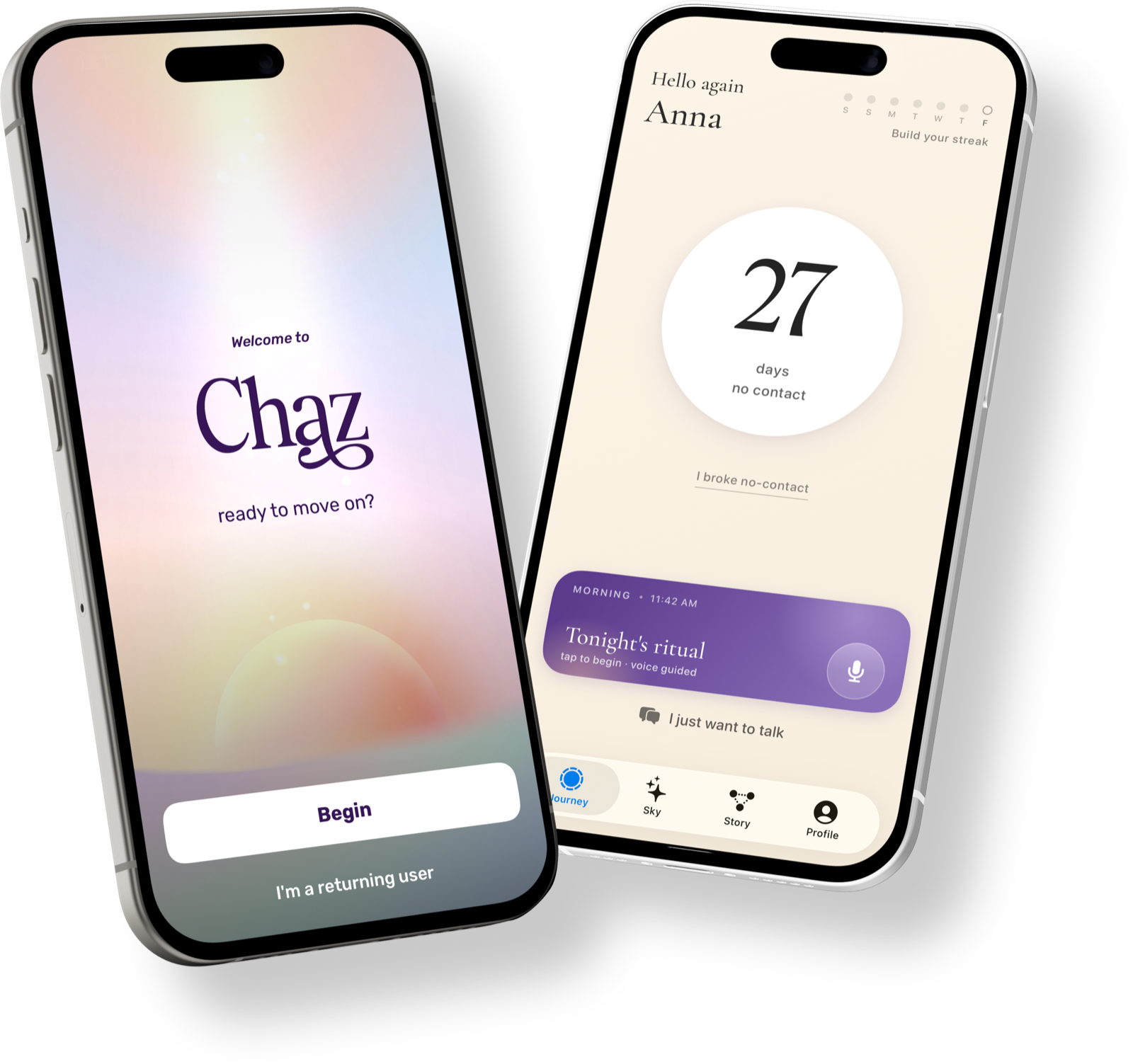
Chaz is built around a specific moment: it's 2:47 AM, you've been staring at the ceiling for forty minutes, and your phone is two inches from your hand. What do you do?
In every other app, the answer is "open it, journal, close it." That's a lot of friction at the worst possible time. Chaz lets you open it and talk. A voice agent listens, talks back, and is on your side. It is sassy in a way that feels like a friend who has been there, not a therapist on a payroll. It roasts you a little. You don't text him.
In the background, your voice transcripts become journal entries. So you also end up with a written record of the recovery, without having to type at 2 AM.
Best for: The middle of the night. The "I just need to say this out loud to something" moment. Active no-contact.
Not the best for: Structured daily lessons. Production-grade audio courses. Clinical guided meditations. Use a meditation app or therapy alongside.
Cost: Free. iPhone only.
2. Mend — best for guided audio "trainings"
Mend pioneered the breakup-as-course model. Short audio segments on specific topics, prompted journaling, mood tracking. If you respond well to "listen to a 9-minute audio about why rebound relationships fail" as a format, this is for you. Calmer than Chaz, more structured, no roasting.
Best for: People who want to be guided through recovery with audio content, like a podcast that is actually about you.
Not the best for: The interruption moment. Mend is not built around "press this button when you're about to text him."
Cost: Free trial, subscription afterward. Verify pricing on the App Store. iOS and Android.
See the head-to-head: Chaz vs Mend for the full breakdown.
3. Rx Breakup — best for daily routine
Rx Breakup gives you a lesson per day with a journal prompt. If you like checklists, this works. If you find daily homework triggering, skip it.
Best for: Structured people who want a "do this each day" approach.
Not the best for: Crisis moments.
Cost: Limited free, paid tier. iPhone.
4. Breakup Boss — best for tone
Breakup Boss is text-based, witty, and built on cognitive behavioral therapy principles. The exercises are good. The tone is warm. The "kick in the pants" feature gives you a randomized push when you need it. Closest in spirit to Chaz, but without the voice piece.
Best for: People who want lightness and humor in their recovery.
Not the best for: Hands-free moments — it requires reading and typing.
Cost: Paid. iOS and Android.
5. Day One — best journal-only option
Day One is not a breakup app. It is the best journal app, and journaling is one of the most evidence-supported tools for processing a breakup. Research on expressive writing (most prominently James Pennebaker's decades of work at UT Austin) consistently shows that writing about an emotional event for 15-20 minutes a day for several days reduces rumination and improves recovery outcomes.
You can absolutely repurpose Day One into a breakup journal. Make a journal called "the breakup," write in it every night. The cost of the friction is that it's not designed for your specific situation, so the prompts are general. The benefit is that you'll have the journal long after the breakup is over.
Best for: Long-term journalers who already keep a daily practice.
Cost: Free tier, premium subscription. iOS, Android, Mac.
6. Calm or Headspace — best for sleep and rumination
Calm and Headspace are not breakup apps. But the single hardest physical symptom of heartbreak, for most people, is the sleep disruption. Calm and Headspace both have sleep stories, breathwork, and short anxiety meditations that genuinely help with the "I cannot get my brain to stop" loop.
Don't expect a meditation app to address the relationship-specific stuff. Do expect it to help you fall asleep at 1 AM instead of at 4 AM.
Best for: Sleep, anxiety, breathwork.
Cost: Free tier, paid subscription. iOS and Android.
7. Wysa or Replika — AI companion alternatives
There are AI chatbot apps not specifically designed for breakups (Wysa is more general mental health, Replika is a friendship-style AI companion). They can fill the "I just need to talk to something" gap. They are not optimized for breakup specifically and won't roast you the way Chaz will, but they exist and they're worth knowing about.
Best for: General mental-health conversation, especially if you're past the breakup-specific stage.
Cost: Free tier, paid subscriptions for full features. iOS and Android.
A comparison table
| App | Category | Best moment | Free tier | Platform |
|---|---|---|---|---|
| Chaz | No-contact + AI + journal | 2 AM impulse | Yes (free) | iPhone |
| Mend | Audio program | Morning commute | Limited | iOS, Android |
| Rx Breakup | Daily lessons | First coffee | Limited | iPhone |
| Breakup Boss | CBT, text | Throughout day | Paid | iOS, Android |
| Day One | Journal | Bedtime | Yes | iOS, Android, Mac |
| Calm / Headspace | Meditation | Lying awake | Limited | iOS, Android |
| Wysa / Replika | AI chat | General venting | Yes | iOS, Android |
Verify current pricing and availability on the App Store. The breakup-app space changes fast.
The honest stack
If you wanted to do this fully, the stack would be:
- One no-contact tracker with interruption built in. Chaz, or any of the free no-contact apps.
- One journal practice, even if it's just five minutes a night. Day One, the Notes app, or paper. Pennebaker's research suggests fifteen minutes for several days is the minimum dose to see effects.
- One sleep / anxiety tool if your nights are wrecked. Calm, Headspace, or any breathwork app.
- A human. A therapist if you can swing it. A friend if you can't. Apps are scaffolding, not replacement.
The mistake people make is downloading seven apps in the first week and using none of them by week three. Pick one or two. Use them. Add more only if you actually want more.
What the research actually says about apps and healing
The clinical evidence on breakup-recovery apps specifically is thin — most of these apps haven't been formally studied. What has been studied are the underlying tools they use. The picture is consistent:
- Expressive writing. Pennebaker and others have shown that writing about emotional experiences reduces rumination and improves physical health markers over months. (Journals, voice transcripts.)
- Behavioral activation. A core component of cognitive behavioral therapy, well-supported in meta-analyses for depression and grief: doing things that used to give you pleasure, even when you don't feel like it. (Replacement-behavior nudges.)
- Sleep restoration. Strongly associated with emotional recovery. (Meditation, breathwork, sleep stories.)
- Social contact. Loneliness slows healing. (Voice agents and AI companions are imperfect proxies for friends, but they are better than nothing at 2 AM.)
- Limiting reminder exposure. Research on rumination supports environment design — reducing the cues that trigger the loop. (Blocking the ex's number, hiding photos.)
A good app is a delivery vehicle for one or more of these. Chaz tries to bundle expressive writing, behavioral activation, and social contact into one moment. That is the design bet.
Don't expect an app to do the whole thing
This is the part nobody on a comparison post says, so I'll say it. An app is a tool. A breakup is a months-long event. The tool helps you get through specific moments. The healing happens in between, in conversations with friends, in time, in the slow rewiring of your nervous system.
If the breakup is recent and acute, the app you need is one that helps you get to tomorrow. That's a no-contact tracker with something to do at night.
If the breakup is older and you're past the acute phase, the app you need is one that helps you reflect. That's a journal or an audio program.
If you're feeling clinically depressed, not just heartbroken, you don't need an app — you need a person, ideally a licensed one. There's a real difference between breakup depression and clinical depression. Take it seriously.
Now go install one thing. One. Open it tonight. Use it. Healing is boring and slow and consists almost entirely of small choices that nobody else sees. The app is just there to make a few of those choices easier.